How to Stay Focused in a Hyperconnected World:
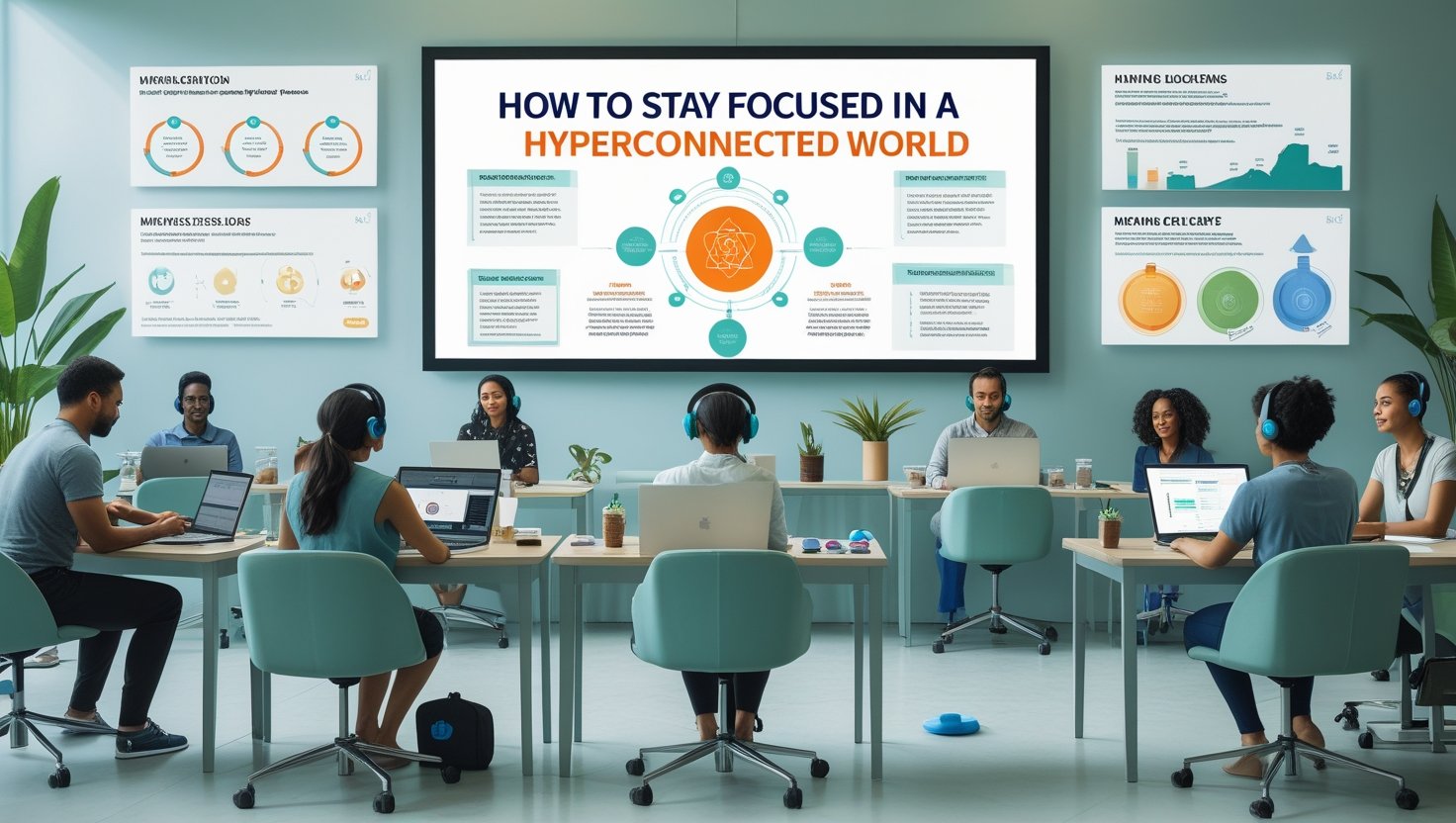
The modern age is one of the densest digital forests, where at every moment, there is someone’s notification, message, or any update shown on your phone, which is drawing attention. Nowadays, there is a storm of information on every corner, that why it is difficult for us to manage social media, breaking news, and other notifications that keep us busy at every single moment of our life which distracting us from our actual goals.
We thought that multi-tasking is an efficiency, but in reality, it tires our brains and distracts our focus every time. In every single second, we receive an alert or update on our phones, some are important, but almost 80% is content that is not beneficial to us in the long term. The notification is drawing over brain’s attention to the phone without thinking about what you are doing at that particular moment. This digital overload causes low productivity in a person, but increases our mental fatigue, that why nowadays being focused on any task is a skill.
In this blog, we will understand what the real root of distractions is, how the brain reacts, and what the practical steps are, with the help of which we can regain our attention and make our life more meaningful and productive.
1. Understanding the Distraction Dilemma:
Nowadays, at every single moment of our lives, our phones’ notifications and their apps distract our attention; for that reason, we can’t concentrate on our tasks. Our brain is not designed for multitasking by nature, that why when you receive any new alert or message on your phone, it grabs our attention toward it and breaks our focus on the current task that will perform by us.
The design and algorithm of social media apps are made in such a way that we constantly engage with those apps without knowing it. When distraction is increased, so person loses their precious time and energy, and wastes their valuable energy, due to which we a lose our productivity for our actual work. Understanding and accepting the problem is the first step to regaining your focus.
2. The Science behind Focus and Attention:
The design of our brains is one task at a time because it has selective attention, which helps us to focus on a single task at a time, and it blocks all other unessential information at that time. When we check our phone at every instant, the work changes rapidly, so our attention is reduced from our actual task, and decreases our focus on our actual task. At every notification or alert on our phone a dopamine is released, which activates our reward system and makes us addicted to that.
Again and again, multitasking is becoming a habit for our brain, but it can’t focus on a single task for a long time, and causes significant damage to our brain in the long term. For understanding Focus and attention, we need to study the scientific process of our mind. For a reason to train our brain for better concentration in our daily life tasks.
3. Identifying Your Digital Distractions:
You need to keep a record of your screen time, either using your phone or computer, and how much time you spend your time on your phone or Computer, and what you were doing at that particular time, whether you were using social media or playing games on the computer. You need to observe your record of your screen time and what you will do at that particular time that which app will engage you most of the time without any reason.
Observe that when you shift your focus from your actual task without any specific reason. This shift of focus at every instant is the reason behind the loss of focus on the actual task. Understand which part of the day will distract you from your actual task, and what factor is involved in breaking focus on your actual task. Once you understand the actual distraction, you will be able to control it.
4. Strategies to Reclaim Your Focus:
Using the time blocking technique, in which you fix your time for a particular task and focus on that particular task for the interval of time, the next strategy is the Pomodoro Technique. In this strategy, we will work for 25 minutes and take a rest for 5 minutes. It will help you to work efficiently without losing focus.
Another strategy is to shut off the notifications on your phone; it enforces the silent or vibrate mode while you’re working. You need to fix the particular time for your Social media accounts and emails so that you don’t need to turn on your phone at every moment while working. Mindfulness, for example, Meditation or Deep breathing exercises daily for 10 minutes, helps reduce the pressure and increase focus of the human mind.
5. Creating a Focus-Friendly Environment:
Remove every distracting material from your workspaces so that you will be fully able to concentrate on your work. The use of noise-canceling headphones or slow-paced music in the background will help you to focus on your actual task a keep your attention away from any kind of distraction.
When you want to do deep work. Place your phone outside of your workspace so it will not be able to distract you from your actual task. For working comfortably and focused, the work desk is a light system with proper lighting for your eyes, and the chair is also comfortable for better focus and makes no phone zones for your offices and homes to be distracted from your actual task.
Conclusion:
In a world constantly buzzing with notifications, updates, and digital noise, staying focused has become less of a natural trait and more of a trained skill. This blog has explored how our minds are biologically wired for single-tasking, not the constant switching that modern technology demands from us. It’s clear that distractions are not just external; they are deeply tied to how our brains respond to stimuli like dopamine-triggering alerts and algorithm-driven engagement.
By understanding how focus works, identifying the triggers that pull us away from our goals, and applying strategies such as time blocking, the Pomodoro Technique, and mindfulness, we can begin to take back control of our attention. Creating a physical environment that minimizes distraction is equally crucial. Whether it’s turning off notifications, building no-phone zones, or setting up a workspace optimized for concentration, these small changes make a big difference.
Ultimately, the focus in the digital age is on being intentional. When we choose to prioritize deep work, guard our time, and engage in tasks with full presence, we increase not just our productivity but also the quality and meaning of our lives. The challenge is real, but with awareness and discipline, focus can once again become our greatest strength.
FAQs:
Q1: Why is it so hard to stay focused in today’s world?
It is hard to stay focused because we live in a time where we are surrounded by constant notifications, messages, alerts, and updates from our phones and devices. Every few seconds, our brain is pulled in a new direction, and this makes it very difficult to stay focused on one single task at a time
Q2: Is multitasking good for productivity?
Multitasking may seem like a smart way to get more done, but in reality, our brain is not built for doing many things at once. It quickly gets tired and loses its ability to focus properly, which leads to mental fatigue, lower quality of work, and less productivity in the long run
Q3: How does technology affect our attention and focus?
Technology affects our focus by sending us frequent alerts and updates, which release dopamine in the brain, and this dopamine makes us feel rewarded and pushes us to keep checking our devices again and again. This habit breaks our focus every time and makes it difficult to return to deep and meaningful work
Q4: What can I do to reduce digital distractions?
You can reduce digital distractions by using techniques like time blocking or the Pomodoro method, turning off unnecessary notifications, placing your phone away while working, setting fixed times to check emails or social media, and practicing mindfulness like meditation to train your brain to stay calm and focused
Q5: How can my workspace help me focus better?
Your workspace plays a big role in focus, so it should be clean and free from distractions. Keep your phone outside the room or out of sight. Use noise-canceling headphones or soft music, make sure your desk has good lighting, and your chair is comfortable also, create no-phone zones at home or office to help you concentrate better