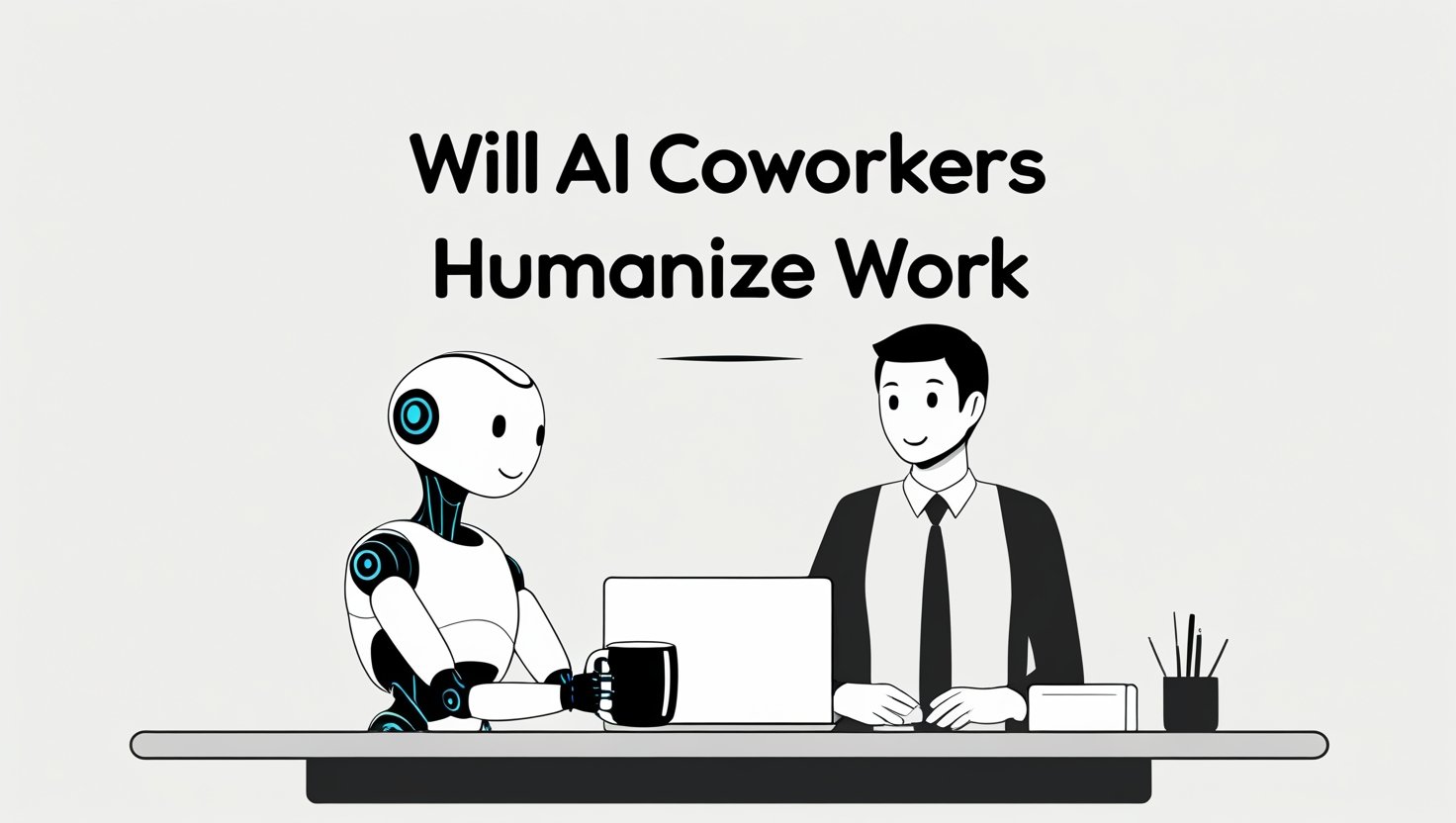
What if your next teammate doesn’t drink coffee, never takes a sick day, and is powered by code? Meet your new AI coworker.
Imagine this, you’re stuck on a big project. Instead of stressing alone, you ask your computer for help. In seconds, it suggests ideas, organizes your files, and even drafts an email, freeing you up to do the creative thinking you love. This isn’t science fiction; it’s the future of work happening now. The big question isn’t just whether AI will replace jobs, but something far more interesting: Can AI coworkers actually make work more human? It sounds backwards, but by handling the boring, repetitive tasks we dislike, artificial intelligence at work might just help us become more us: more creative, more collaborative, and more human.
Beyond the Robot Takeover:
The fear that a robot will steal your chair is a common movie plot. But in reality, the story is shifting. The goal of most workplace AI integration today isn’t replacement, it’s partnership. Think of it like the first calculators. They didn’t replace mathematicians; they freed them from tedious long division to focus on solving complex theories. Similarly, AI tools for collaboration are designed to be the ultimate assistants, taking over the tasks that drain our energy so we can focus on the tasks that light us up.
This human-AI collaboration creates a new model where humans are the captains, steering the ship with intuition and ethics, and AI is the powerful engine, providing the speed and data to get there.
The Unexpected Gift of Time:
Our most precious resource at work isn’t paper or paperclips, it’s time. So much of it is lost to necessary tasks, but not personally fulfilling. This is where an AI coworker shines brightest.
- Taming the Email Dragon: AI can sort your inbox, highlight urgent messages, and even draft polite replies. This means less time spent on admin and more time for deep, thoughtful work.
- Meeting Magic: Imagine an AI that joins your video call, takes perfect notes, identifies action items, and sends a summary to everyone before you’ve even grabbed a fresh glass of water. This reduces misunderstandings and makes meetings shorter and more effective.
- Research Rocket Fuel: Need to analyze a year’s worth of reports? An AI can read thousands of pages in minutes, find the key patterns, and present the highlights. This gives you the information you need to make smart decisions faster.
By handing off these tasks, AI for administrative tasks gives us the gift of time. And what we do with that time is where the humanization happens.
From Human Resources to Human Relationships:
This is the most surprising twist. By handling the hard data, AI might be the key to unlocking our soft skills. Soft skills are things like creativity, empathy, communication, and teamwork, things that make us uniquely human.
When an AI handles data entry, an employee has more mental space to think of a creative new marketing idea. When an AI translates languages in real-time, team members from different countries can communicate more clearly and build stronger relationships. The technology becomes a bridge, not a barrier.
In this way, AI in the workplace doesn’t dehumanize us; it allows us to prioritize the human parts of our jobs that often get pushed aside by busywork.
The Irony of Machines Teaching Us to Connect:
Here’s a beautiful paradox: a machine can teach us about human connection. AI-powered analytics can analyze team communication and gently suggest, “It looks like the design team hasn’t been included in this thread,” helping to ensure no one is left out. It can remind a manager to check in on an employee who has been working late consistently, promoting employee well-being.
This isn’t about a robot being in charge; it’s about using smart tools to build a more thoughtful, inclusive, and connected work environment. It helps us see the human patterns we might miss on our own.
Keeping the Human Touch:
Of course, this new world isn’t perfect. We must be careful. Over-relying on AI could make us lazier or less skilled. The key is to always view AI as a tool, like a super-smart pencil. The pencil doesn’t write the story; you do.
The most important future of work with AI will be built on a foundation of trust and transparency. Employees need to understand how the AI works and trust that it’s there to help them, not spy on them. Companies must use AI to empower people, not just to track their every keystroke.
Conclusion:
So, will AI coworkers humanize work? The answer is a hopeful yes, but with a condition. Yes, if we use them wisely. AI collaboration tools have the incredible potential to remove the dull tasks that make work feel like a grind. By doing so, they can give us back our time, our mental energy, and our focus. This allows us to invest more in creativity, strategy, and, most importantly, in each other. The future of work isn’t about humans versus machines. It’s about humans and machines working together to create a more productive, creative, and ultimately, more human workplace for everyone.
FAQs:
1. Will an AI coworker take my job?
Probably not; it’s more designed to take over your boring tasks, not your entire role.
2. What can an AI coworker actually do?
It can summarize meetings, organize emails, analyze data, and draft simple documents.
3. Can AI understand human feelings?
No, AI doesn’t feel emotions, but it can analyze data to help humans make more empathetic decisions.
4. Will using AI at work make my skills weaker?
Not if you use it to handle repetitive tasks, freeing you up to practice and improve your higher-level skills.
5. How can AI improve teamwork?
It breaks down language barriers in real-time and ensures everyone has access to the same information instantly.
6. Is AI expensive for companies to use?
Many helpful AI tools are very affordable, making them accessible to businesses of all sizes.